Two variables the mould cannot negotiate
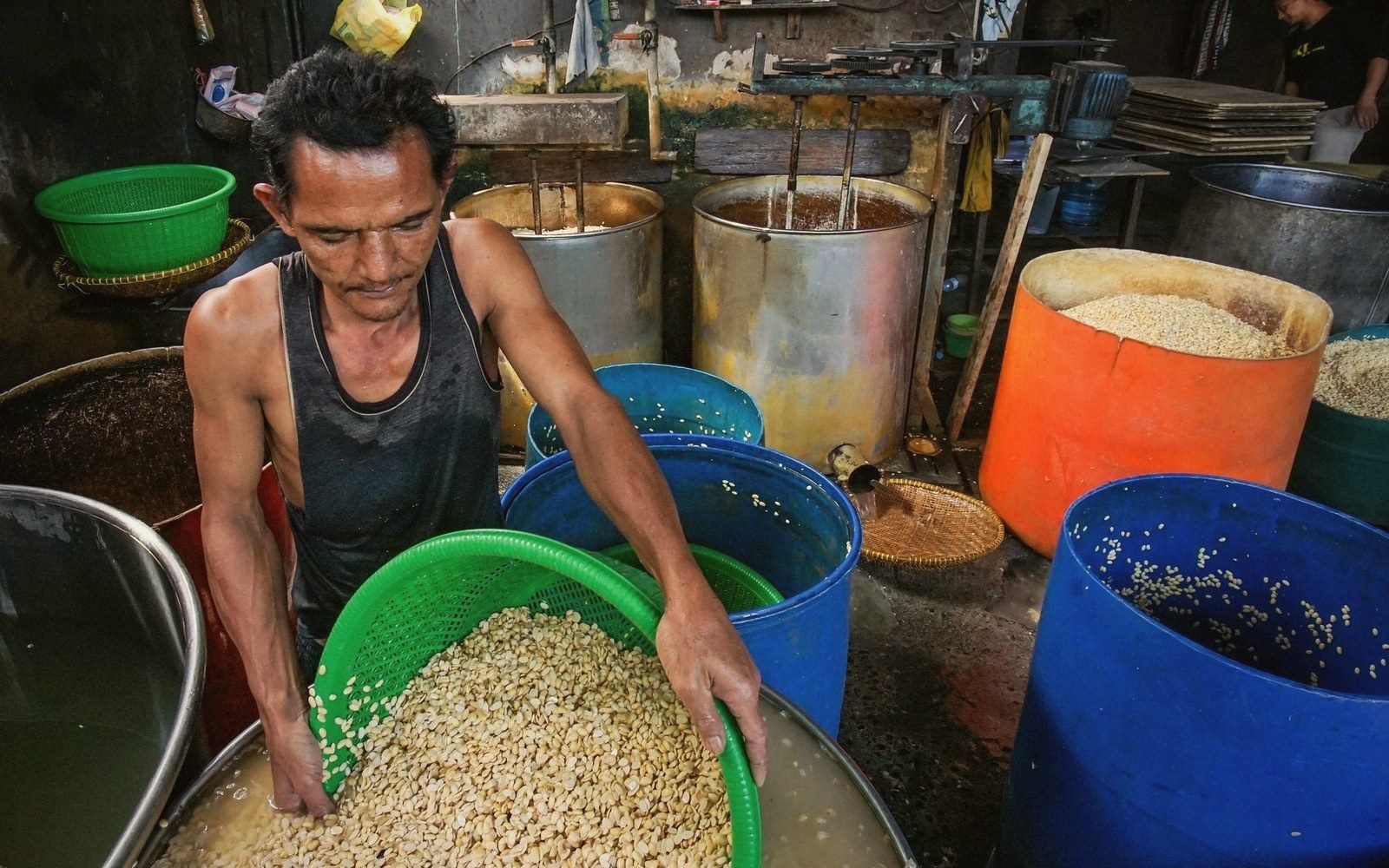
Rhizopus oligosporus, the fungus responsible for tempeh, cannot penetrate a whole soybean. The seed coat — the hull — is a physical barrier: waxy, tough, and essentially impermeable to the mycelium that needs to thread through the cotyledon and knit the beans into a cake. Hulling removes it. This is not a textural refinement; it is a prerequisite for growth.
The hull splits most readily after soaking. Soybeans typically soak for eight to twelve hours, absorbing enough water to swell and loosen the outer skin. Once swollen, the hull can be rubbed free by working the beans between your palms, or by briefly pulsing them in a food processor — enough to crack and loosen, not enough to break the cotyledons into fragments too small to bind. Fragments still ferment, but a cake of rubble has little structural integrity. After rubbing, the hulls float free during rinsing and can be poured off; several changes of water clear them reliably.

Acidification happens in the same window. Lowering the pH of the beans — typically to around 4.5 to 5.0 — serves two purposes. First, it discourages bacteria that would otherwise compete with Rhizopus during the warm incubation period. Second, and less obviously, Rhizopus itself germinates and grows best in a mildly acidic environment; neutral or alkaline conditions favour competitors and slow the mould. The simplest method is to add a small amount of vinegar — white or cider, roughly one to two teaspoons per litre of soaking water — during the final soak or as a brief acidic rinse after the hulls are removed. Some producers rely on a natural lactic-acid fermentation during the extended soak: left long enough at room temperature, the soak water acidifies on its own as bacteria produce lactic acid. Both methods work; the vinegar route is faster and more controllable.
Drying the beans before inoculation is the step that links both preparations together. Wet bean surfaces inhibit spore adhesion and dilute the starter culture unevenly. After hulling, rinsing and acidifying, the beans are spread on a clean surface and dried — by air, or briefly in a low oven — until the surface is visibly dry but the interior remains hydrated. A bean that is wet outside and dry inside is wrong in both directions; the goal is an even, damp interior with a surface that a dusting of spores can cling to.
Get both steps right and the incubation window can do its work. Miss either and no amount of warmth rescues the batch.