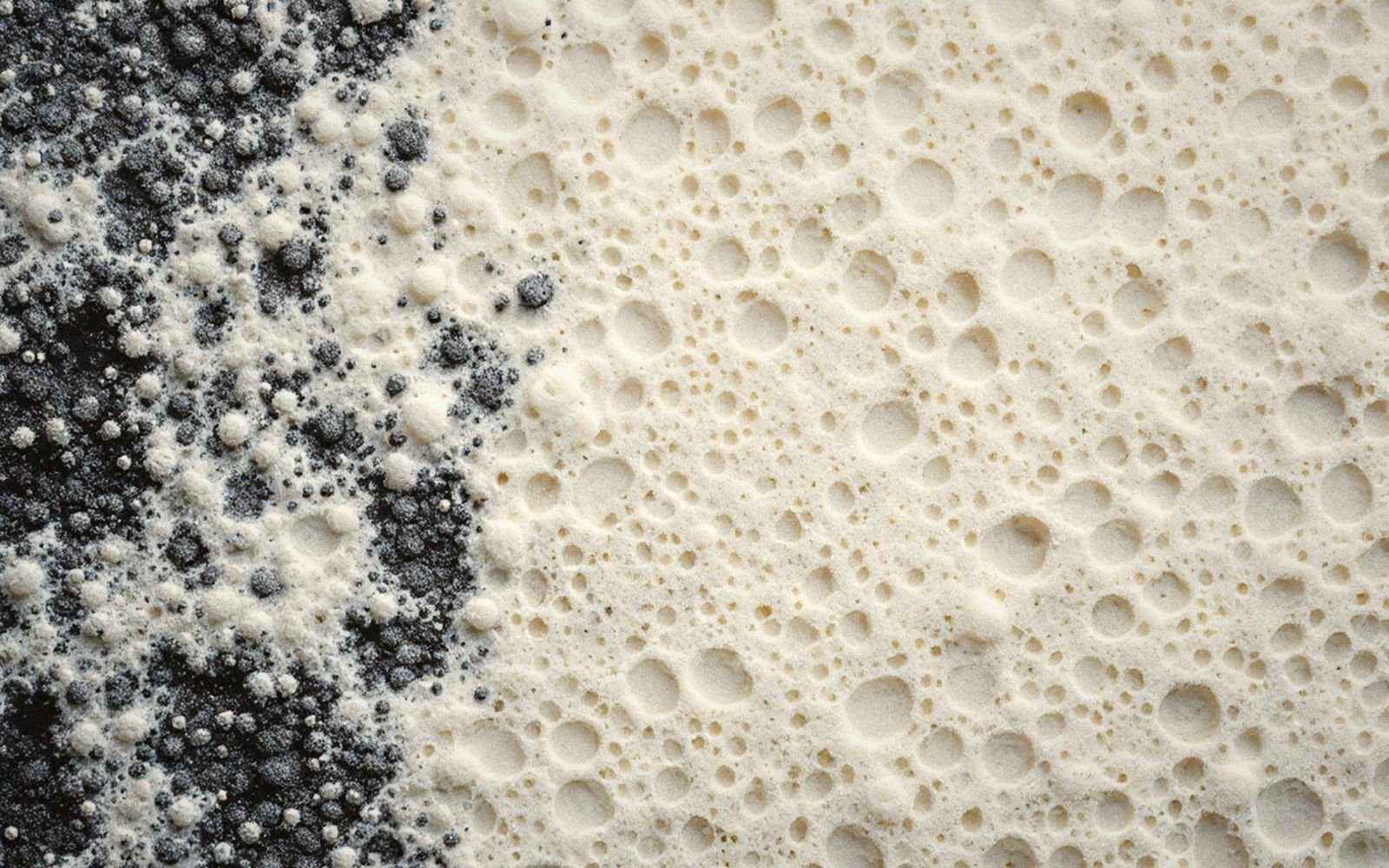
The colour is a signal, not a flaw
Rhizopus oligosporus starts white. The mycelium — the fine fungal threads knitting cooked soybean cotyledons into a single cake — is colourless for most of its useful life. The white you see on a young tempeh cake is dense, healthy growth binding everything together. It is what you want.
Then, given enough time or warmth, the colour shifts. Patches of grey or black appear, first at the surface, then spreading. This is sporulation: the mould has moved past its vegetative phase and begun producing spores. The spores are pigmented, and pigmented spores are what grey tempeh is showing you.

The problem is not aesthetic. Sporulation is a metabolic pivot. While the mycelium was growing, Rhizopus was generating heat as a by-product of its own respiration — the incubation window that matters is, in part, about managing that heat before it drives the culture toward exactly this transition. Once sporulation begins, the character of the cake changes: ammonia production rises, the flavour sharpens toward bitter, and the texture of the mycelial mat weakens. The compact, sliceable structure loosens.
Sporulation is triggered by a combination of time elapsed, accumulated heat, and CO₂ concentration. A cake that has been incubating too long at a temperature above roughly 31–32 °C will grey faster than one held at the cooler end of the range. Wrapping that is too airtight compounds the problem: CO₂ builds up and acts as an additional sporulation signal. Perforation of the wrapper moderates this by allowing gas exchange without drying the surface out entirely.
The practical rule is simple: pull the cake when it is uniformly white and the beans are fully bound. A small grey patch on the outermost surface is not a disaster — those spores are the same Rhizopus culture, and a thin grey edge does not penetrate far. A cake that is substantially grey throughout has passed its peak. It is still edible, but it is not the same food. Cook it hard — a long braise absorbs the sharpness — and adjust the process next time: lower temperature, shorter incubation, or better airflow.
The colour is a clock face. White means the clock is still running in your favour.