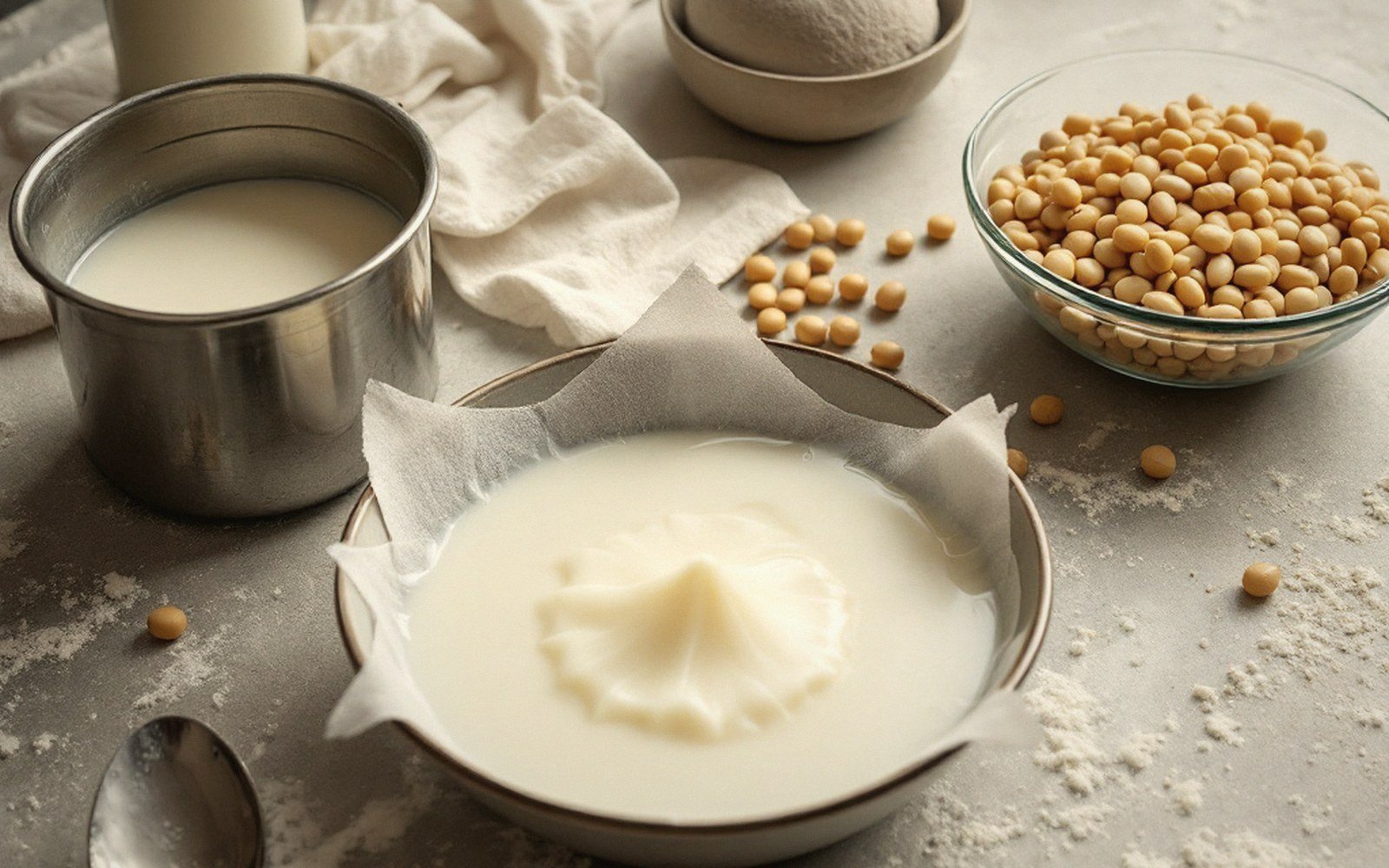
Two ingredients in one liquid
Drain a can of cooked chickpeas and hold the liquid up to the light. It is slightly viscous, faintly golden, and it foams if you shake it. That last quality is not incidental — it is the whole point, and it comes from two classes of molecule doing two distinct jobs.
The first class is protein. During cooking, chickpea proteins leach out of the beans and dissolve into the surrounding water. These are predominantly legumin- and vicilin-type storage proteins, the same family found in most pulses. In solution they are flexible molecules: when you whip the liquid and drive air bubbles in, these proteins migrate to the air-water interface, unfold partly, and form a continuous film around each bubble. That film is what makes foam physically possible. Without a surface-active protein to coat the bubble wall, air simply escapes and no foam holds.
The second class is saponins. These are natural detergent-like compounds — glycosides with a fat-soluble core and a water-soluble sugar chain — and chickpeas contain them in meaningful quantities. Saponins reduce surface tension dramatically, which makes it far easier to subdivide the liquid into tiny bubbles in the first place. You can think of them as the foaming catalyst: they lower the energy cost of creating new surface area, so whipping produces bubbles faster and with less mechanical effort. Saponins alone, though, form only transient foam. The bubbles appear quickly and collapse just as quickly, because saponins are small molecules that pack the interface loosely.
The two components are therefore complementary. Saponins get the bubbles formed; proteins hold them. The proteins build structural continuity across the bubble wall — neighbouring molecules linking through weak hydrophobic interactions and, over time, limited disulfide bonds — while the saponins keep surface tension low enough that new bubbles keep forming rather than merging immediately. Take either class away in isolation and the foam either forms poorly or drains within seconds.
There is a third factor worth naming: soluble starch and oligosaccharides. These thicken the continuous liquid phase between bubbles, slowing drainage and buying time for the protein film to stabilise. They contribute texture rather than foam architecture, but they explain why aquafaba from long-cooked or canned chickpeas outperforms a light home broth — more time in contact with the beans means more of everything dissolved.
What this means in practice: the quality of your foam is set before a whisk touches it. A dilute, pale liquid is protein- and saponin-poor; a dense, slightly sticky one is rich. Air in bean water follows from what that liquid actually contains.
Setting Point is an independent publication about food technique — not a shop, restaurant, or nutrition service.