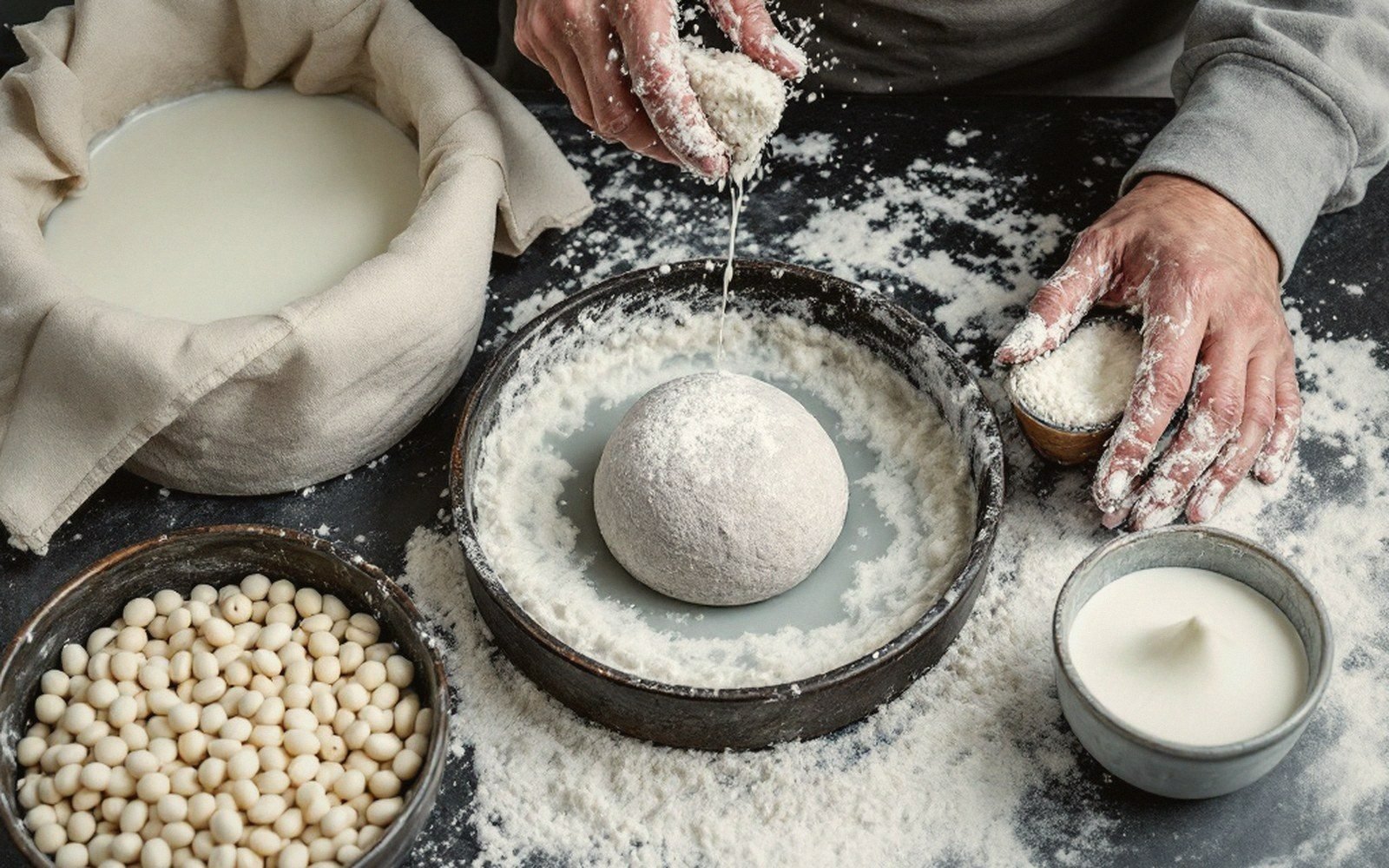
The network forms before the rinsing begins
Wheat flour contains two storage proteins, glutenin and gliadin, sitting inert among granules of starch. Add water and both proteins hydrate, but they do not yet form the stretchy, cohesive mass a cook recognises as gluten. For that, mechanical work is required.
Kneading does two things simultaneously. It unfolds the glutenin molecules — long, coiled chains that, once extended, can align alongside each other — and it brings them close enough for disulphide bonds to form between adjacent sulphur-containing amino acid residues. These covalent cross-links stitch glutenin chains into a continuous, elastic scaffold. Gliadin fills the spaces within that scaffold: it is smaller, more globular, and contributes plasticity rather than elasticity — it is what allows the network to flow and stretch rather than simply snap. Together, the two proteins produce a viscoelastic material: it springs back like rubber and yields like soft clay, depending on the timescale and force applied.
The ratio matters. Flour milled from hard wheat varieties carries more total protein and a higher proportion of high-molecular-weight glutenin subunits, which cross-link readily and build a stronger, more elastic network. Soft wheat flour has fewer of those subunits; its gluten develops faster but holds less tension. This is why bread flour and cake flour, both milled from wheat, behave so differently under the same hands.
Rest also plays a role before washing begins. A dough left to sit after kneading allows the network to relax — disulphide bonds redistribute, stress within the mass equalises, and the dough becomes easier to handle without tearing. Resting is not passive: it is continued structural reorganisation without further input of energy.
Once the network is properly developed — typically ten to fifteen minutes of firm kneading for bread-flour dough — the starch is still there in quantity, loosely bound among the protein strands rather than chemically attached to them. That is what makes washing out the starch possible: water can infiltrate the mass and carry starch granules away while the gluten network, held together by covalent bonds, remains intact. Wash underdeveloped dough and the network tears apart; wash a well-kneaded dough and it tightens into a smooth, elastic ball as the starch leaves.
The order of operations is not arbitrary. Kneading builds the structure; washing reveals it. Skip or shorten the first step, and the second step has nothing to show.
Setting Point is an independent publication about food technique. It is not a shop, restaurant, or nutrition service.