What each coagulant is
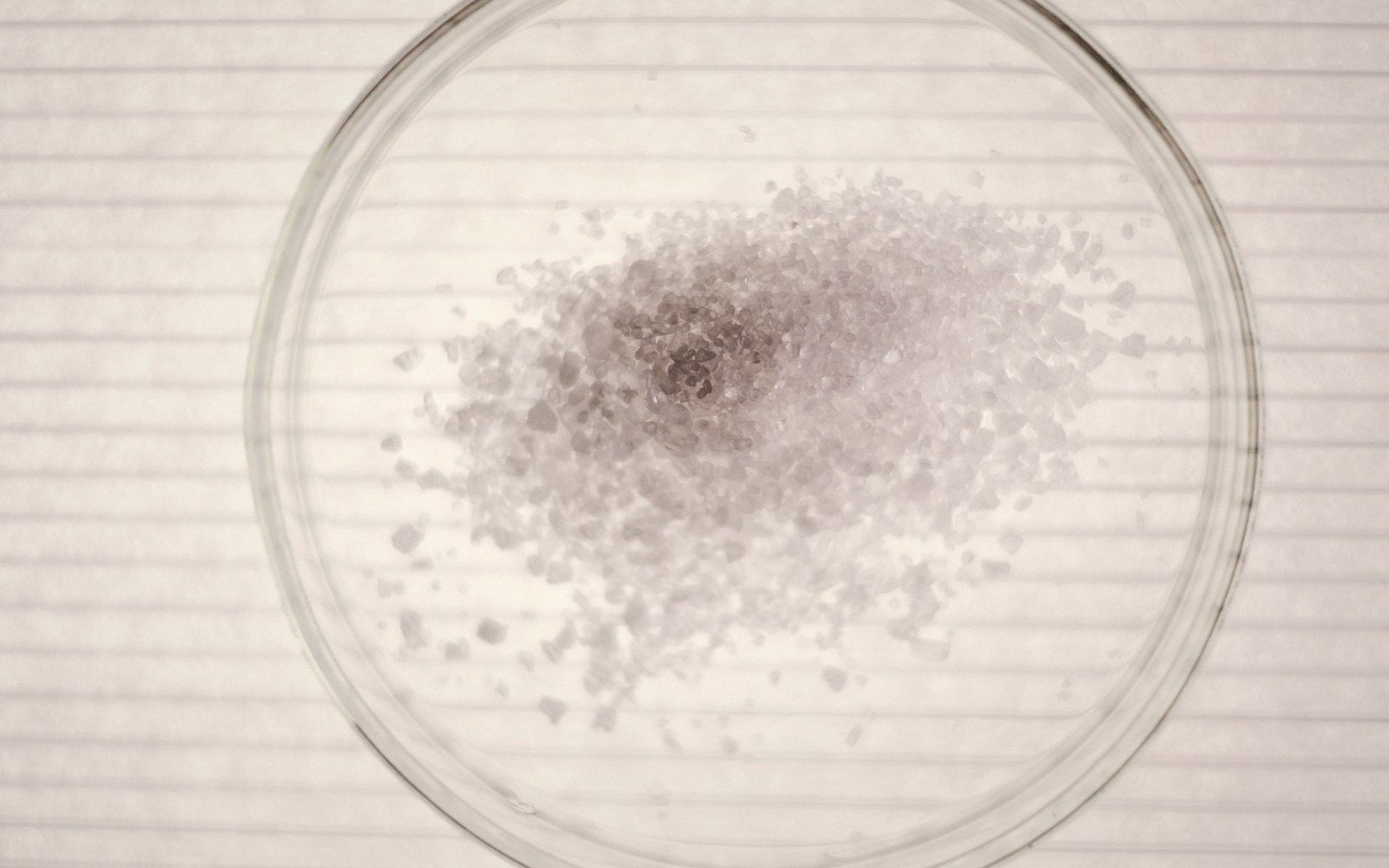
Nigari is the Japanese term for the bitter mineral liquor left behind after sodium chloride is crystallised out of seawater. Its active ingredient is magnesium chloride, though commercial nigari also contains traces of magnesium sulphate and potassium chloride. Gypsum, used in tofu-making, is calcium sulphate dihydrate — the same mineral that hardens plaster of Paris, mined and food-grade processed before it reaches a kitchen. Both are salts. Both deliver a positively charged divalent cation into warm soy milk to neutralise the negatively charged protein particles and trigger coagulation. Beyond that, they behave almost nothing alike.
The mechanism of speed
Magnesium chloride dissolves readily in water and dissociates fully. Drop it into hot soy milk above roughly 70 °C and free magnesium ions are immediately available in quantity. They strip the electrostatic repulsion from soy protein particles — chiefly the globulin fractions, 11S glycinin and 7S β-conglycinin — almost instantly, and the proteins aggregate fast. That speed is the defining characteristic of nigari. It gives the cook a narrow window: the coagulant must be stirred in gently, evenly and quickly, because the curd begins to form before mixing is complete. Any turbulence after the first moments tears the nascent network, producing coarse, uneven curds.
Calcium sulphate behaves differently because it is barely soluble in water — only around two grams per litre at room temperature. When the powder is dispersed into soy milk, it does not flood the system with ions. Instead it dissolves slowly as the ions already in solution are taken up by proteins, maintaining a low, steady concentration throughout the coagulation process. The result is a much gentler, more uniform aggregation. The proteins have time to organise into a fine, even network rather than clumping in whatever region received the most ions first.
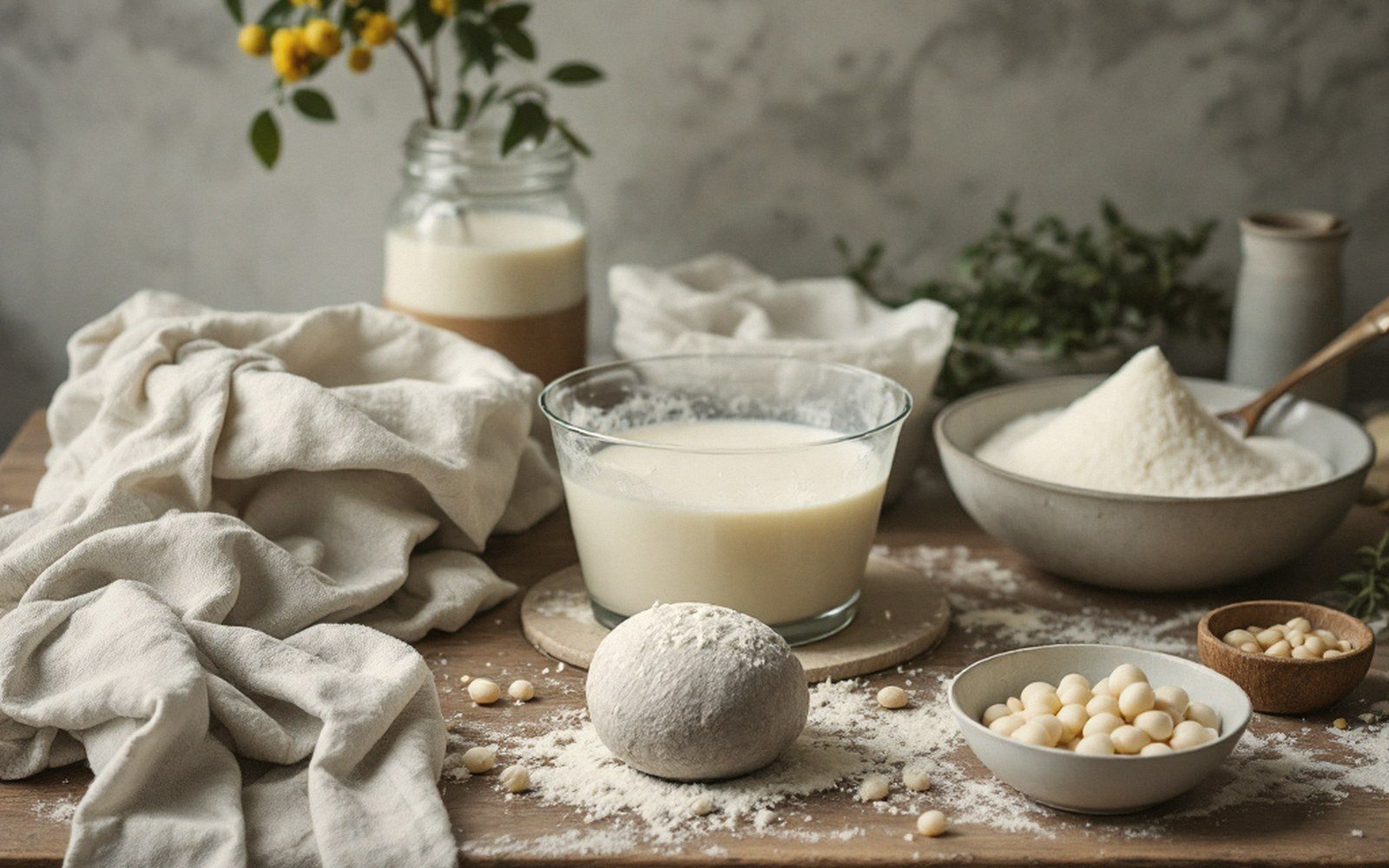
This difference in ion release rate is the entire mechanical story. Nigari is fast; gypsum is slow. Everything else — texture, flavour, process tolerance — follows from those two words.
What the cook actually tastes and handles
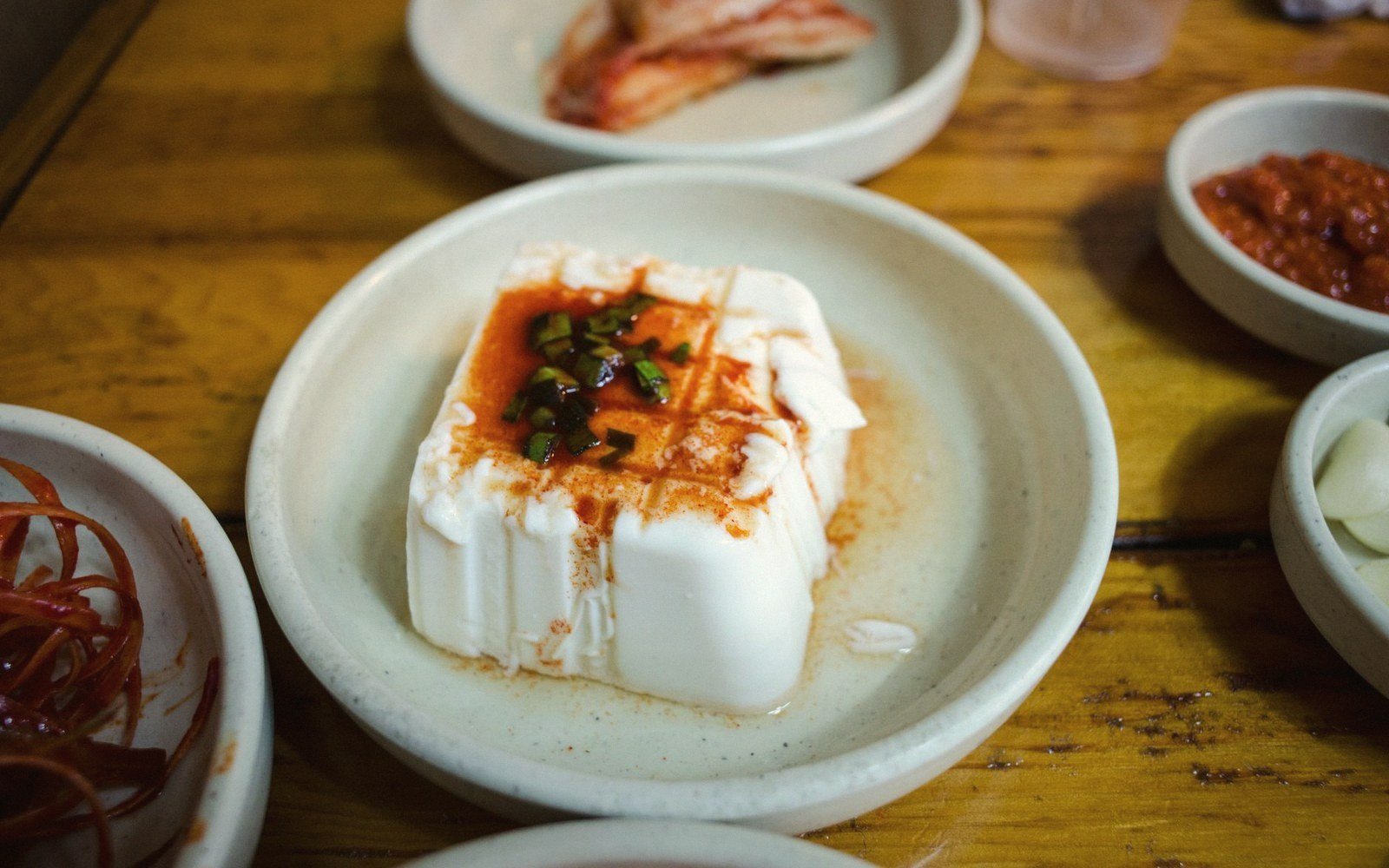
A nigari-set tofu has a more pronounced flavour: the residual magnesium and trace minerals from seawater carry a faint oceanic bitterness that most experienced tofu eaters identify as characteristic and desirable. The texture, when well-made, is springier and more cohesive, with a slight resilience under the tooth. It holds its shape during slicing and survives moderate heat without falling apart, making it well suited to pressing into firm or extra-firm blocks.
Gypsum-set tofu is cleaner in flavour — calcium sulphate itself is nearly tasteless — and the texture is demonstrably softer and more homogeneous at equivalent water content. The fine-network set that slow ion release produces translates into a custardy smoothness. This is the preferred coagulant for silken tofu, where the curd forms inside the final container with no subsequent pressing or handling, and where surface continuity matters enormously.
Process tolerance is another practical difference. Nigari demands precise temperature control and a delicate hand with the stirring — beginners find it punishing. Gypsum is more forgiving; the slow set gives the maker time to distribute the coagulant before aggregation begins, and small errors in timing or temperature produce milder faults. Chinese-style tofu, particularly the soft, dense blocks common in Cantonese cooking, is almost universally gypsum-set for exactly this reason. Japanese-style tofu, where the mineral flavour is considered integral, leans toward nigari, though many commercial producers blend both coagulants to capture some of each quality.
The blend approach is a real technique, not a compromise. Adding gypsum first to slow the initial set, then a small quantity of nigari to reinforce network strength, allows a maker to tune both flavour and texture across a range that neither coagulant achieves alone. The temperature window for coagulation matters to both, but nigari's fast kinetics make it far more sensitive to temperature drift — drop below 70 °C before adding it and aggregation becomes sluggish and incomplete; go too high and the curd forms before the coagulant is dispersed, producing a grainy, fractured block. Gypsum is more patient at every point.
Same protein, same heat, same goal. Two salts, and between them, the full range of what tofu can be.
Setting Point is an independent guide to plant protein as food science — technique, mechanism and process. It is not a shop, restaurant or nutrition service.