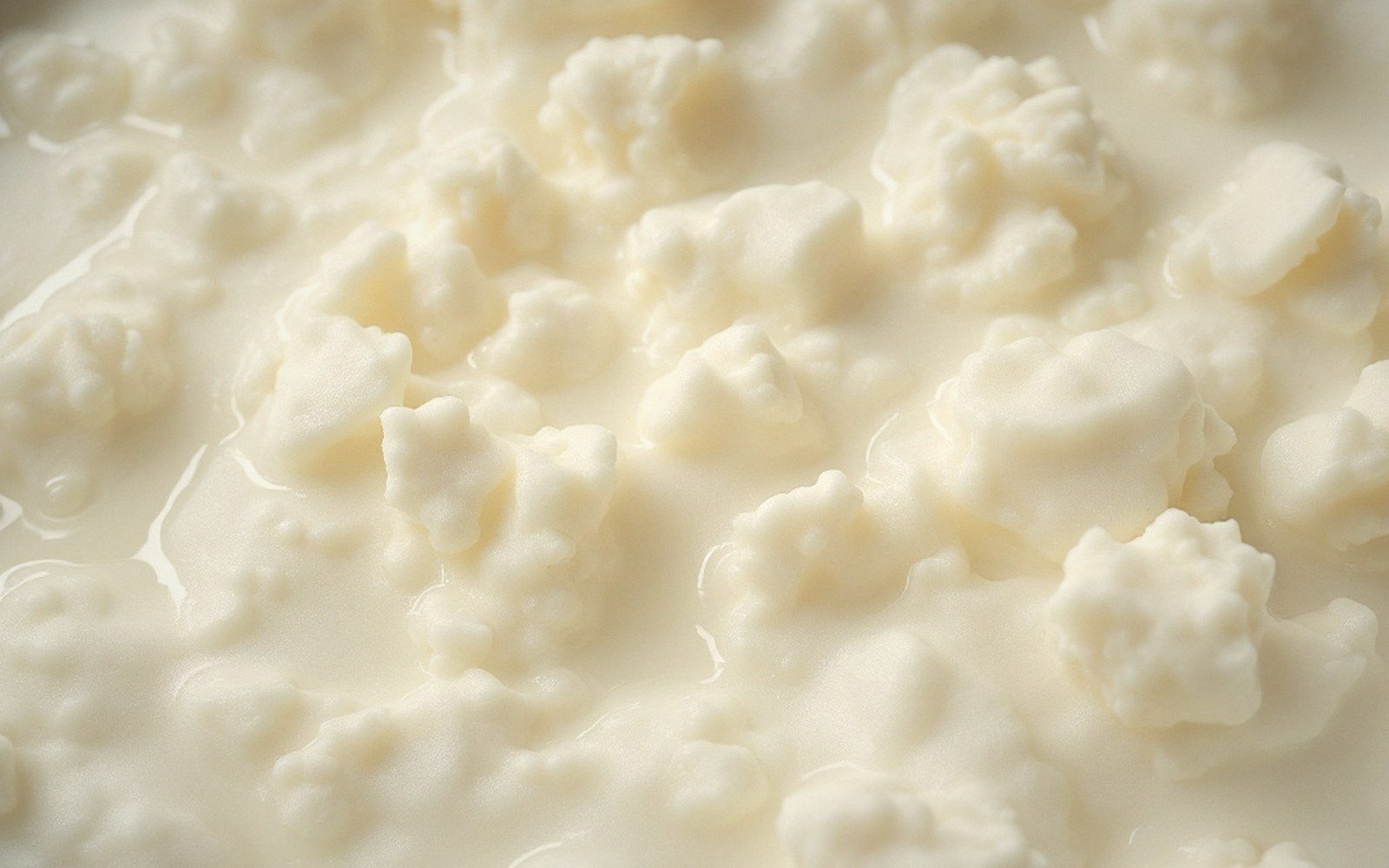
What soy milk actually is
Before the coagulant goes in, it helps to understand what you are working with. Soy milk is not a true solution — it is a suspension of globular proteins, chiefly glycinin and β-conglycinin, dispersed through water alongside fat droplets, carbohydrates and a collection of smaller compounds. The proteins are folded into compact globes, their hydrophobic cores tucked inward, their charged surfaces keeping adjacent molecules apart. That electrostatic repulsion is exactly what makes the liquid stable. The same repulsion is what the coagulant must overcome.
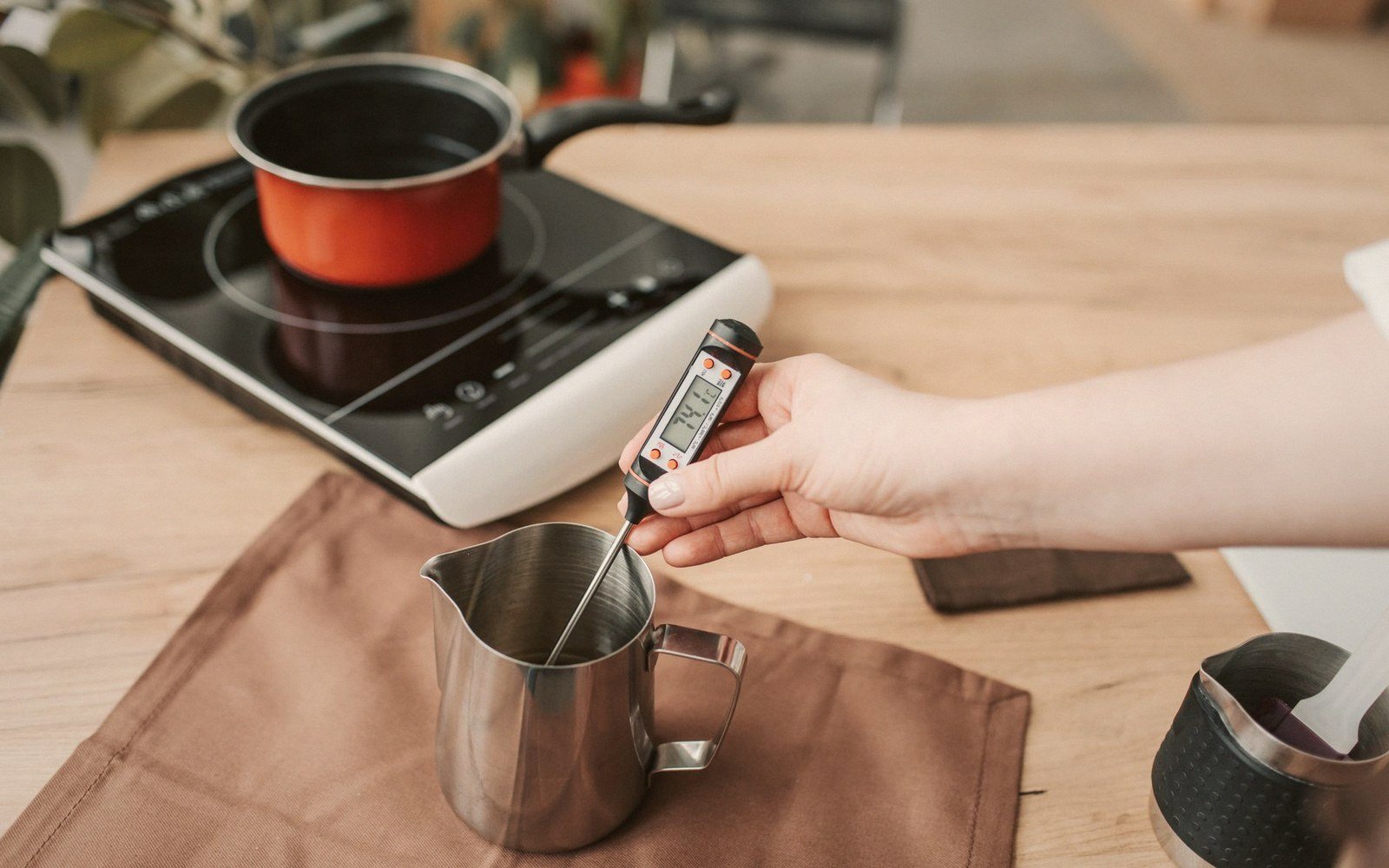
Heat is the first half of the process. When soy milk is brought to around 70–75 °C, the globular proteins begin to denature: the folds open, hydrophobic segments that were previously buried become exposed. The molecule is now reactive in a way it was not before. This is not damage — it is preparation. A protein that has not been heated to this range will not coagulate cleanly regardless of how much coagulant you add, because the reactive sites simply are not accessible. Cold soy milk and a coagulant salt gives you seasoned soy milk, not curd. The temperature window matters before anything else is decided.
The practical ceiling sits somewhere around 90–95 °C for most coagulants. Past that, the denaturation has proceeded too aggressively and too fast: the protein network that forms is coarse, the curd contracts sharply and the result has an unpleasant, grainy texture. The sweet zone — the range in which the protein is open enough to cross-link but not so agitated that it seizes — is relatively narrow, roughly 75–85 °C for most home and commercial processes. Professional tofu production monitors this closely. You should too.
How the coagulant works
Once the proteins are denatured, the coagulant does a precise job: it neutralises or bridges the electrostatic charges that keep the protein molecules apart, allowing them to aggregate. Different salts accomplish this by different mechanisms, which is why they produce texturally different results.
Calcium sulphate — the gypsum used in much commercial tofu — is sparingly soluble. It releases calcium ions slowly and evenly as it dissolves. Those divalent calcium ions bridge adjacent protein chains, linking carboxyl groups on neighbouring molecules into a tight but orderly network. The slow ion release means the network forms gradually, giving a smooth, even curd. Magnesium chloride — nigari, the traditional Japanese coagulant derived from the liquor remaining after salt is harvested from seawater — is far more soluble. It floods the system with ions quickly, which produces rapid aggregation. The curd sets fast and, in skilled hands, has a more delicate, mineral quality; in less controlled conditions the speed makes it easier to overshoot and end up with a coarse, patchy gel. The choice between them is genuinely a choice of mechanism, not merely taste.
Glucono delta-lactone, or GDL, works differently again. It is not a salt but a lactone that hydrolyses in warm water to produce gluconic acid, which gradually lowers the pH of the soy milk. As the pH drops toward the isoelectric point of the soy proteins — around pH 4.5 to 4.8 — the net surface charge on each molecule falls toward zero, and without electrostatic repulsion the proteins aggregate under their own thermal motion. GDL produces the softest, most homogeneous set, which is why it is the standard coagulant for silken tofu: it sets inside a sealed container with no mechanical disruption, and the gel it forms is smooth enough to tremble.
The mechanics of the moment
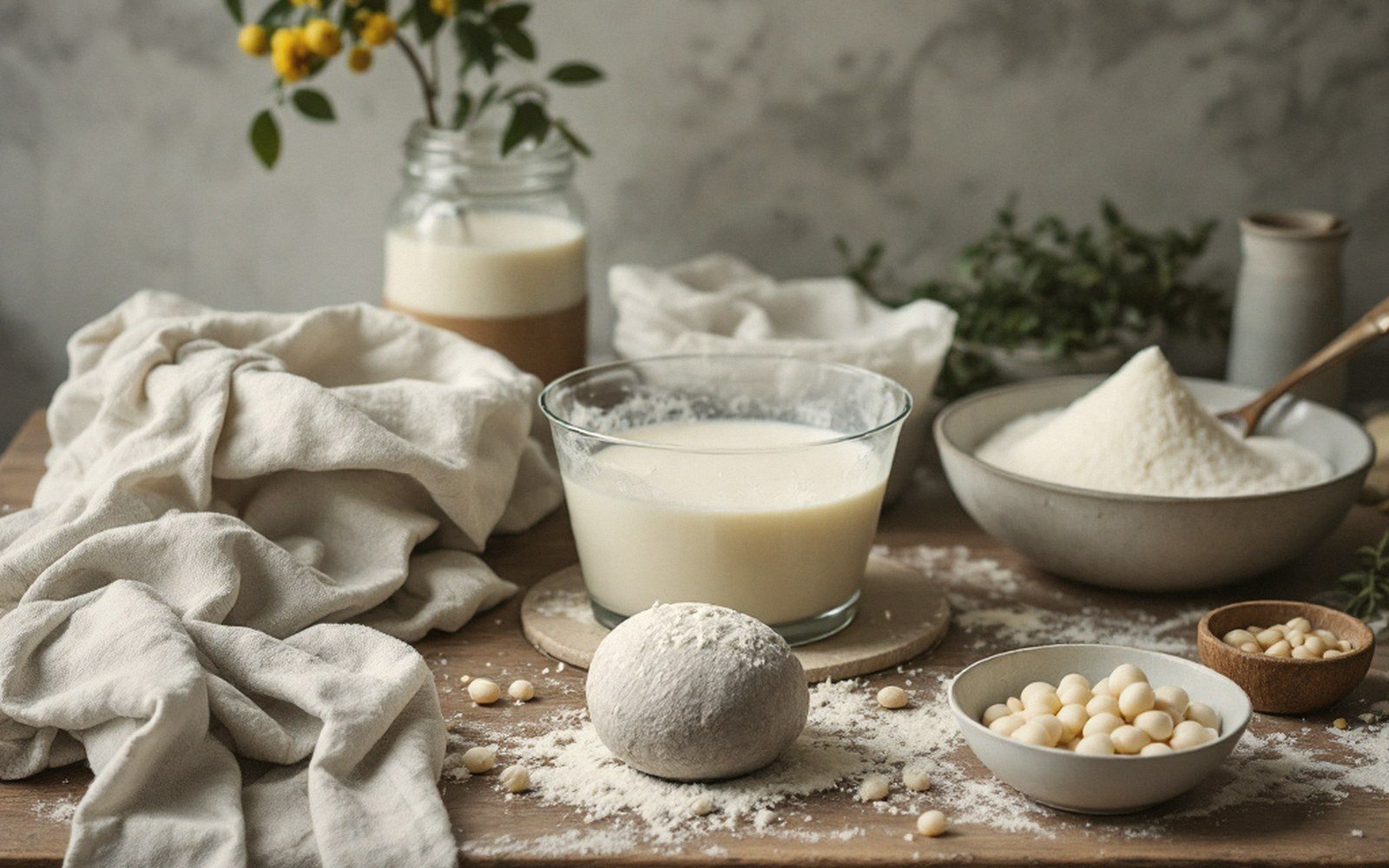
Timing and technique at the point of addition determine as much as chemistry does. The coagulant should be dissolved or dispersed thoroughly before it contacts the hot milk. Adding dry calcium sulphate to the surface of the liquid gives you a lump of coagulant in a puddle of rapidly-setting local curd, not an even distribution. Dissolve it in a small quantity of cold water first.
The method of mixing matters too. One or two gentle folds with a wide paddle — enough to distribute the coagulant, not enough to shear the forming network — is standard practice. Vigorous stirring at this moment breaks the curd aggregates as they form, producing a fine, dispersed curd that is harder to consolidate and gives a less cohesive final product. Some traditional Japanese processes stop stirring entirely after a single sweep and cover the vessel, letting the curd set undisturbed. That stillness is not ceremony. It is giving the network time to form without mechanical interference.
Temperature management during the set is the third variable. If the soy milk cools significantly before the network has fully formed, the kinetics slow and you get partial aggregation: a curd that is weak and irregular, releasing too much liquid when pressed but still containing uncoagulated protein in the whey. Keeping the vessel covered, or setting it in a water bath held at temperature, addresses this. The curd firms as the network of protein chains grows longer and more cross-linked; premature cooling arrests that process mid-way.
Reading what you see
A clean set has a specific appearance: the whey separates as a pale, slightly greenish-yellow liquid, relatively clear, sitting above or around curd that holds its shape when the vessel is tilted. That colour — from riboflavin and other water-soluble compounds — is normal and tells you the protein has largely gone into the curd where it belongs. Milky or opaque whey means protein is still in suspension, pointing to coagulant shortage, temperature too low, or mixing so aggressive it broke the aggregates before they consolidated.
Curd that shatters instead of cutting cleanly, or that contracts violently and expels whey in the first minute, suggests the reaction was too fast — temperature too high, coagulant too concentrated, or a highly soluble salt added without adequate distribution. The curd is coarse because the protein network formed at high speed with short-range order rather than growing into a fine, interlocked mesh. You can still press and use it, but the texture will be noticeably grainy and the yield lower than it should be.
Curd that remains soft after the expected setting time, or that never fully separates from the whey, points the other direction: too cool, too dilute, or coagulant that was added to milk that had not reached the necessary temperature. Nothing in the chemistry can rescue this at the setting stage. The network that did not form cannot be willed into existence by waiting longer. Re-heating and adding more coagulant sometimes salvages the batch, but the result is rarely as good as a correctly executed first attempt.
The setting point, then, is not a single thing but a convergence: protein denatured to the right degree, coagulant distributed evenly and in the right quantity, mixing gentle enough to preserve the forming structure, temperature held long enough for the network to complete itself. Each variable is independent, but they act together. Getting one wrong shifts the burden onto the others, and eventually there is no correction available — only the evidence of what went wrong, and the knowledge to do it differently next time.
Setting Point is an independent publication about food technique and the science under it — not a shop, restaurant or nutrition service.