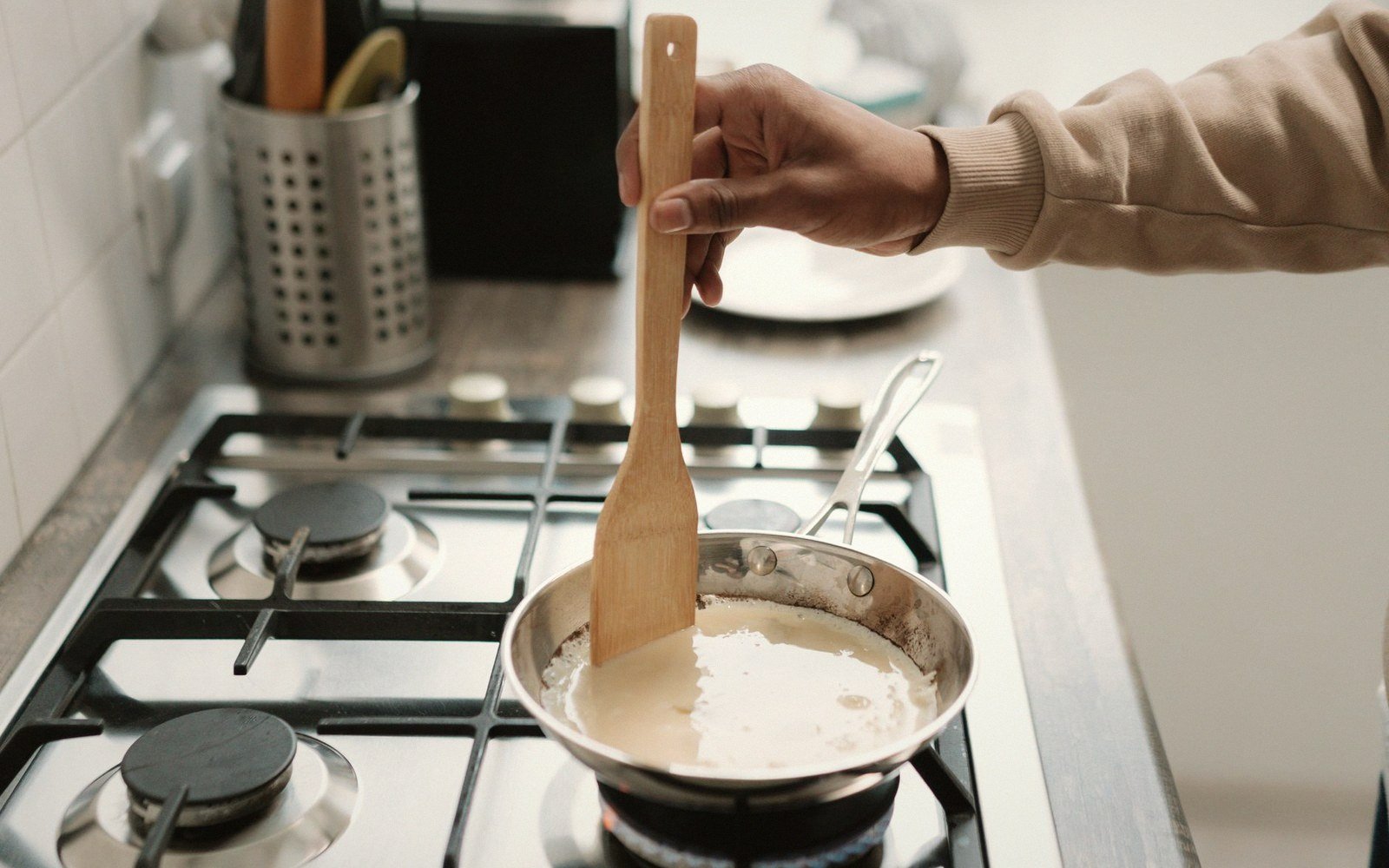
Why the curd refuses to form
Soy milk coagulates because charged proteins lose their mutual repulsion and clump. That collapse needs three things aligned: enough protein in suspension, a coagulant present in the right concentration, and a temperature high enough to have partially denatured the proteins beforehand. Pull any one of those away and the pot sits inert, the liquid milky and unchanged.
Temperature is the most common culprit. Below roughly 70 °C, the globular proteins — chiefly glycinin and β-conglycinin — have not opened up enough to expose the hydrophobic sites that let them aggregate. Add nigari or gypsum to cold or even warm soy milk and the ions do almost nothing useful; the proteins simply close back on themselves. The fix is to bring the milk back above 80 °C before trying again, though a curd set at that point will be patchier than one caught at the right moment the first time.
Dilution is the second lever. Soy milk made from a ratio of roughly 1:5 to 1:6 (dry beans to water by weight) sits at a concentration where coagulation is reliable. Push toward 1:8 or beyond and the protein strands are too sparse to find each other even after the coagulant links them; you get wisps rather than a curd. Reducing the water when grinding, or starting again with a fresh stronger batch, is the only real remedy — there is no way to concentrate a milk that is already in the pot.
Speed of addition matters more than many cooks expect. Coagulant poured in too fast creates localised zones of very high ion concentration. Those zones coagulate hard and fast, leaving the rest of the milk depleted of coagulant and never triggered at all. The result is a small tight knot of protein surrounded by liquid that will not set. The standard corrective is slow stirring while adding, or preparing the coagulant as a dilute solution so concentration spikes cannot form.

A batch that never set is not necessarily lost. If the milk is still at temperature, a fresh, carefully measured addition of coagulant — stirred in gently — can sometimes rescue it. If the milk has cooled, reheat it first, then try. The window is narrow; once the milk has sat a long time at low temperature, the proteins can partially reassociate in ways that resist later coagulation attempts.
Each failure here points to a single variable. A good batch the next day usually requires changing only one thing.
Setting Point is an independent publication about food technique. It is not a shop, restaurant, or nutrition service.