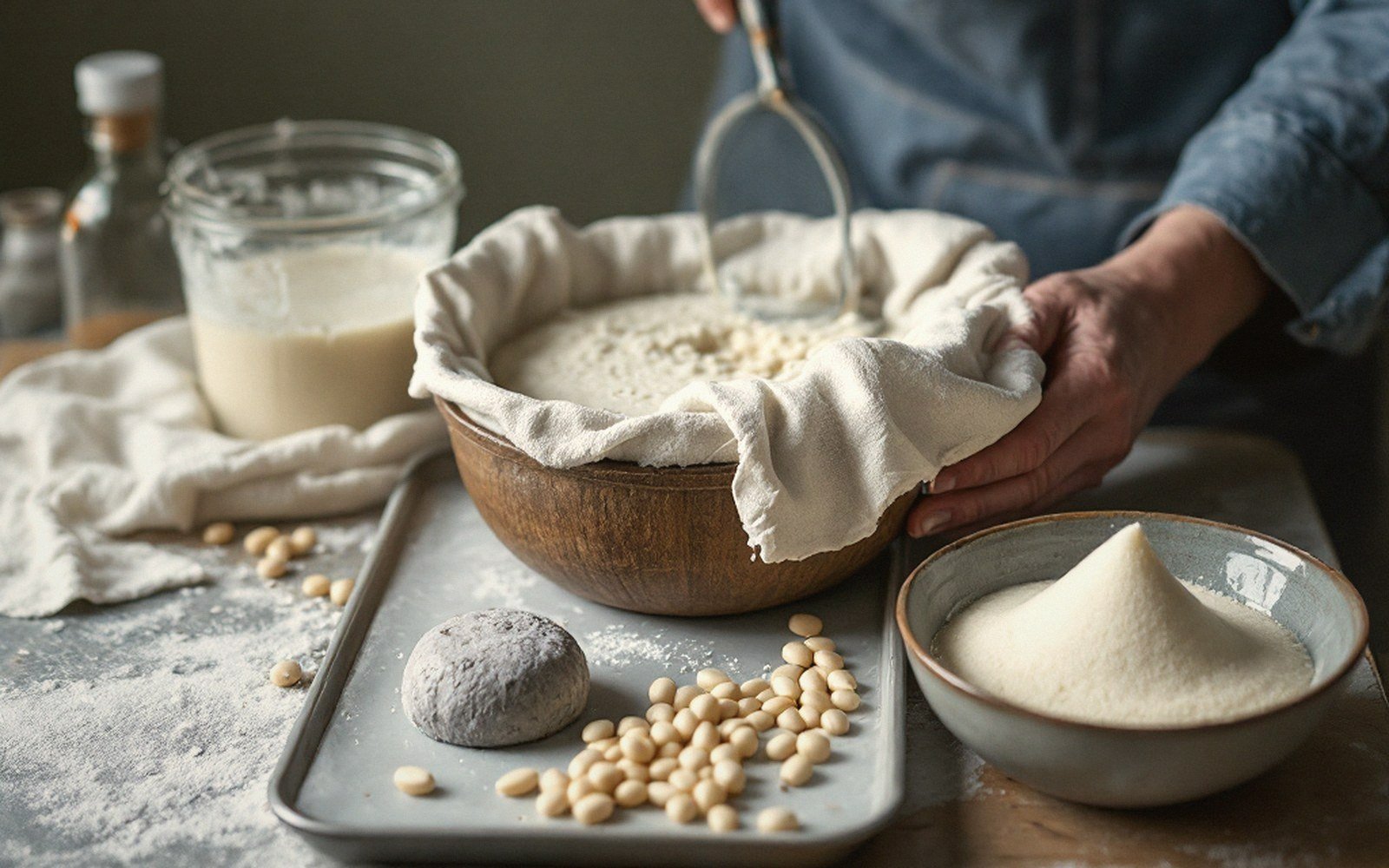
The fault tells you the variable
Pull a washed-gluten mass apart and it should stretch with elastic resistance, hold together cleanly, and bounce back slightly when released. Two things go wrong, and they go wrong in opposite directions: the mass turns rubbery and fights back like a bouncy ball, or it crumbles apart at the gentlest pull, dry-feeling and structureless. Neither is subtle, and neither lies about its cause.
Rubber is the fault of over-development. Gluten is built from two proteins — glutenin and gliadin — that link into a network as the dough is kneaded. That network tightens with mechanical work. If you knead too long before washing out the starch, the cross-links multiply past the point where the network can still stretch gracefully; what you are left with is a mass under permanent tension. Pulling it stretches the whole tightly wound structure at once, and it snaps back hard. The dough may also resist the washing stage, contracting against the current of water, which itself signals over-development. The fix is not to work the dough back — there is no reverse — but to rest it longer before washing. Time under tension lets the bonds relax without breaking, and the network becomes extensible again. If even that fails to tame it, the only correction is at the start: less kneading next time, just enough to develop coherence.

Crumble is the opposite problem — under-development. The proteins are present but have not been given enough mechanical work to align and link into a continuous network. What you have is disconnected protein aggregates, not a web, and disconnected aggregates cannot hold themselves together under tension or even their own weight once the starch is gone. The washing stage sometimes exposes this early: if the mass fragments in the water rather than staying cohesive, the network never formed properly. Continuing to wash it is futile; the fragments disperse. The fix here is equally clear — more kneading before the next wash. The dough should pass a simple stretch test first: a small piece pulled slowly should thin into a translucent sheet before it tears, not tear immediately. If it tears immediately, it is not ready.
A third, related cause of crumble is flour choice. Low-protein flours do not yield enough of either protein to build a network of any density. Bread flour or strong whole-wheat flour is the correct starting material; all-purpose flour sits at the edge of usability, and anything softer is a structural write-off before the kneading even begins.
Both faults are legible. Rubber means stop sooner. Crumble means start longer, or start with different flour.