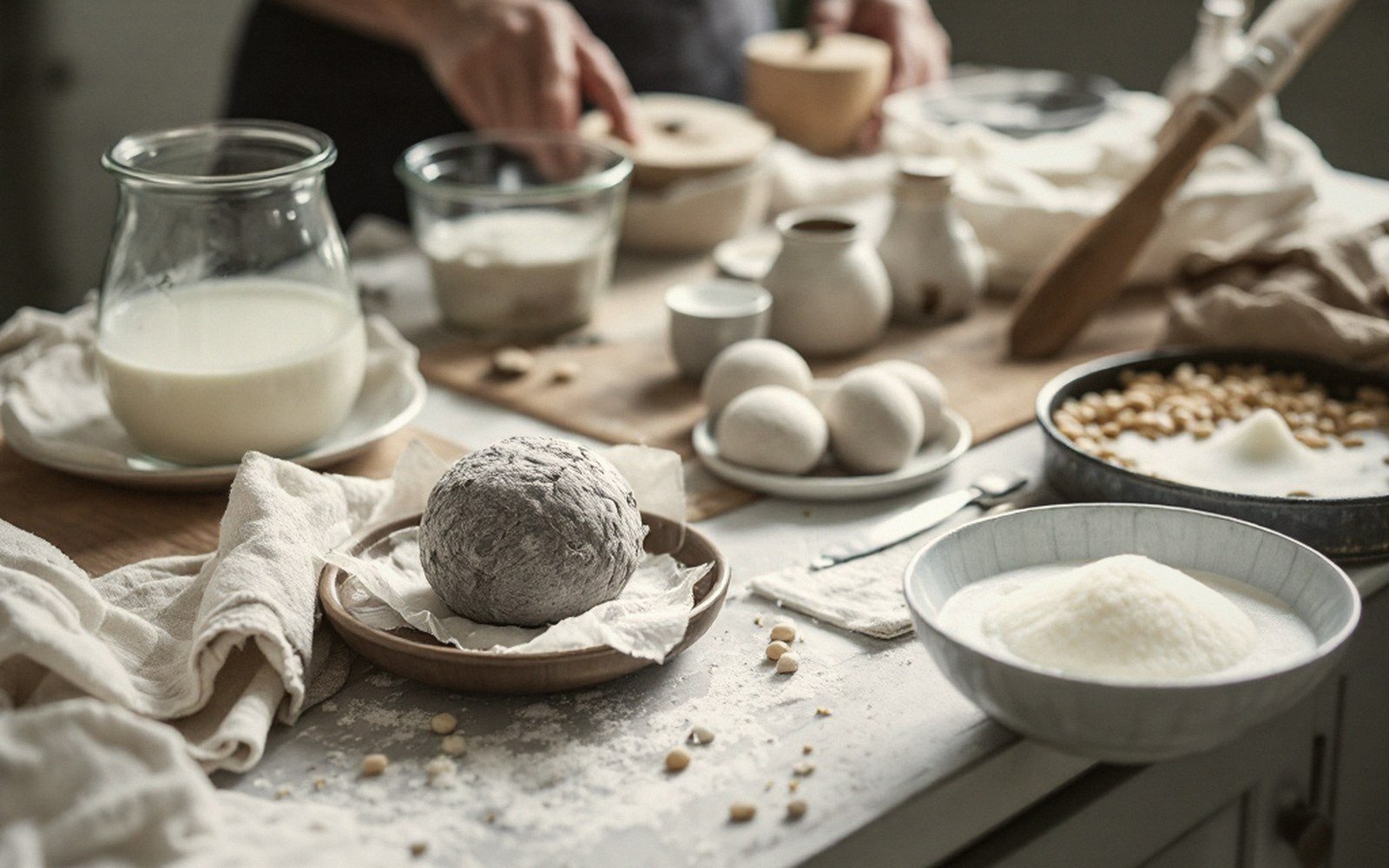
What the colour change tells you
Rhizopus oligosporus, the mould that turns cooked, hulled soybeans into a sliceable cake, spends most of its active life growing white. That whiteness is mycelium — the dense, thread-like network of hyphae knitting the beans together. At this stage the mould is doing exactly what you want: binding, not reproducing. Given enough time, or too much heat, or insufficient gas exchange, the colony shifts its priority. It begins to sporulate, producing the dark pigmented spores that turn the surface slate-grey and then, in advanced cases, nearly black in patches.
The colour is a reliable clock. A faint grey bloom at the edges of a batch, after a full 36 to 48 hours of incubation, is acceptable and expected. A cake that has gone uniformly grey, or that shows grey pushing through into the interior, has been held too long, too warm, or inside a package so airtight that CO₂ accumulated and nudged the mould toward its reproductive phase.

Three variables, one outcome
Time is the most common culprit. Tempeh has a narrow finishing window — roughly 30 to 36 hours at 30 °C is standard; past 48 hours at that temperature, sporulation is near-certain. Pull the batch early and it may not be fully bound; hold it late and the mould pivots.
Temperature accelerates everything. A batch sitting at 34 or 35 °C — easily reached when the mould's own metabolic heat is not being managed — can sporulate in well under 30 hours. The incubation environment needs ventilation precisely to carry away that heat, and a thermometer in the batch, not just in the room, is the only honest reading.

Wrapping is the third variable. Perforations in the packaging exist to exchange oxygen and release CO₂. A wrap sealed too tightly, or perforations too sparse, traps metabolic gases and tips the mould toward spore production. The holes are not decorative.
What you have, and what to do with it
A grey cake is not spoiled — Rhizopus spores are not harmful, and the beans are still fully bound and cooked. The flavour, however, shifts: the ammonia-adjacent note that develops with over-sporulation sharpens, and the texture becomes softer and more fragile as the mycelium begins to autolyse. For immediate eating it is still usable, particularly in strongly seasoned applications where the flavour is absorbed rather than featured. For any preparation where tempeh's mild, mushroomy baseline matters, the grey batch will disappoint. The fault is instructive: it names the variable — time, temperature, or wrap — and tells you exactly where the next batch needs tightening.
Setting Point is an independent publication about food technique. It is not a shop, restaurant or nutrition service.