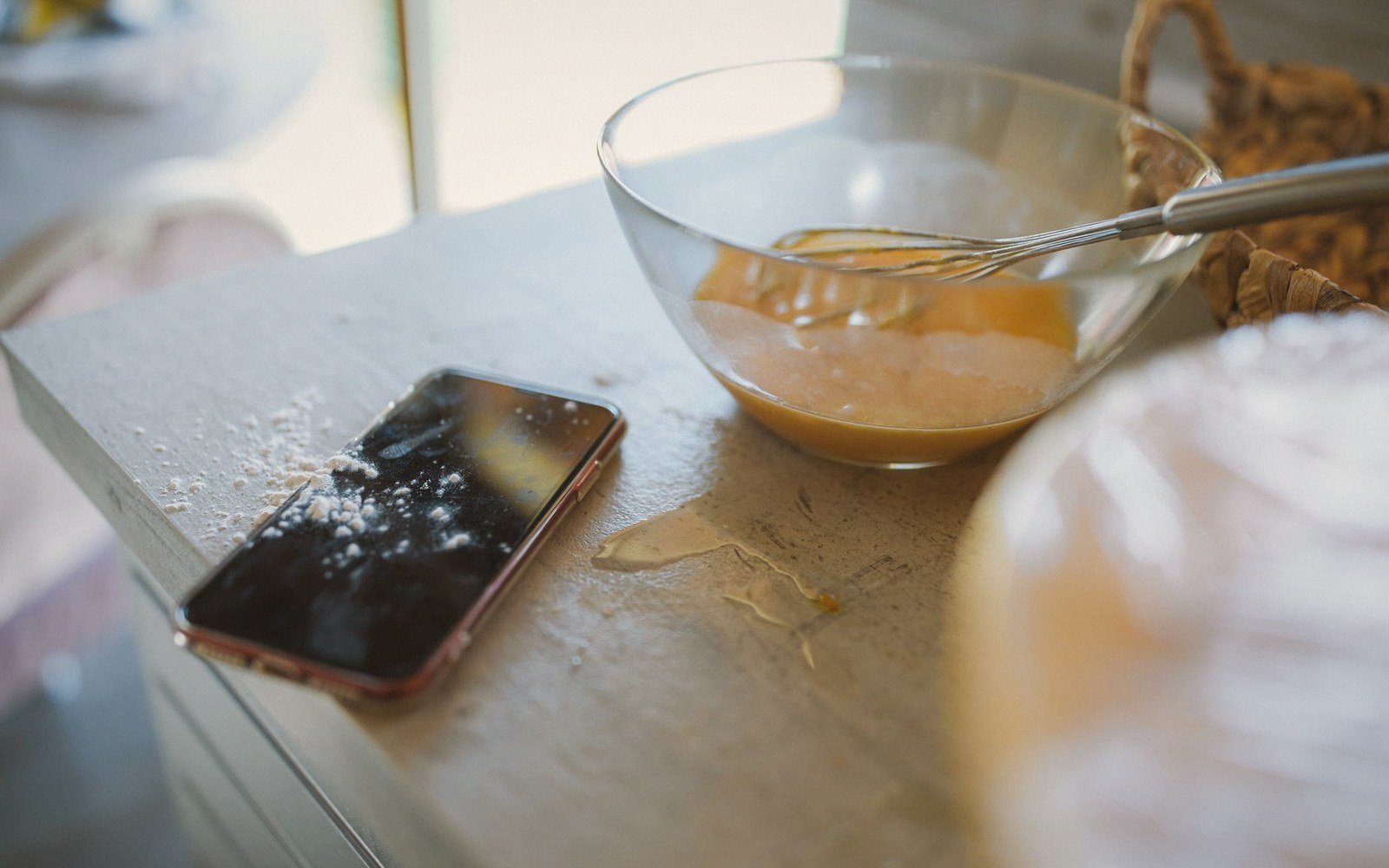
The curd, the gluten, the cake, the foam — four processes, four failure modes
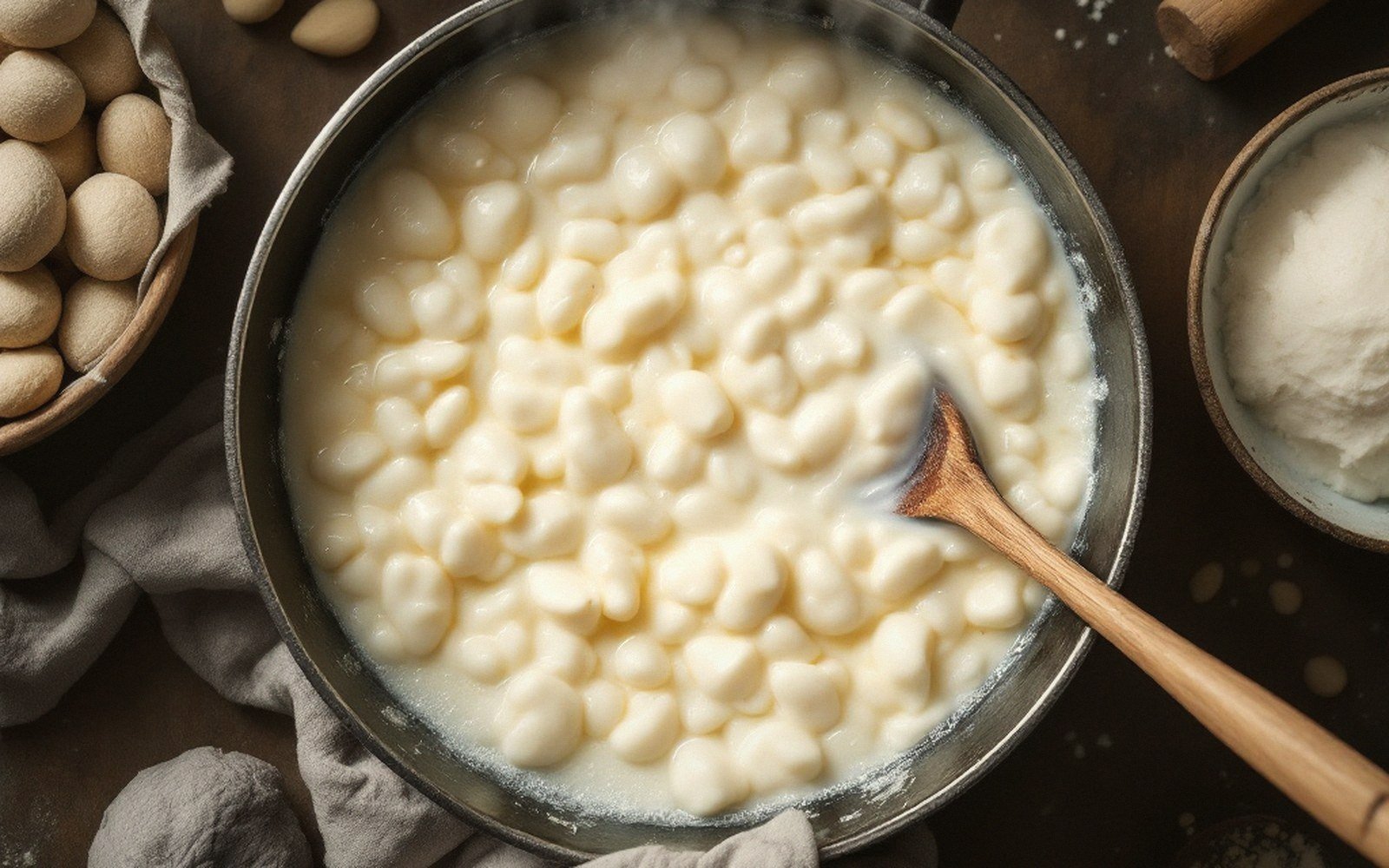
Soy milk curds when a divalent salt disrupts the electrostatic charge that keeps proteins in suspension, causing them to aggregate and sink. That mechanism has exactly the number of things that can go wrong: temperature, coagulant concentration, speed of addition, and the dilution of the milk itself. A curd that never arrives — milk that stays opaque and fluid no matter how long you wait — is almost always a temperature problem or a dilution problem. Below roughly 70 °C the proteins haven't fully denatured and won't aggregate cleanly; too thin a milk and there simply aren't enough protein molecules close enough to find each other. A curd that arrives but shatters when you lift it, crumbling into fine white grains rather than holding a clean face, points the other direction: the coagulant was added too fast, or in excess, and the proteins seized before they could knit into a coherent network. These two faults look nothing alike, and that is the point — the curd that never came and a curd that came too hard are opposite failures with opposite remedies.
Gluten is simpler in some ways, more forgiving in others. Wash starch out of a flour dough and what remains is a viscoelastic mass whose behaviour is governed almost entirely by development and hydration. Rubbery seitan — the kind that bounces back against the knife and squeaks against the teeth — means the network was overdeveloped or the simmer was too aggressive: a rolling boil tightens the structure and makes it dense and tough where bare movement would have preserved it. Crumbly seitan means the opposite: underdeveloped gluten that was never given the kneading time to form continuous cross-linked chains. The fault is structural, and you can read it on the cut surface — a tight, slightly shiny interior for the overdone batch; a rough, grainy break for the underdone one.
Tempeh fails more slowly, and the failure is visible before it is tasted. Rhizopus oligosporus, the mould responsible for knitting cooked beans into a sliceable cake, is sensitive to temperature in both directions and to oxygen supply. Too warm and the mould's own metabolic heat pushes the incubation environment past the point where growth continues; the mycelium dies back, the beans stay loose, and the surface develops dark wet patches rather than the firm white mat you're after. Too cool and the culture never really starts — the beans sit inert. A cake that has gone uniformly grey or black has not failed in the same sense; it has simply gone further than you wanted. Sporulation is the mould completing its lifecycle, and white then grey is a clock, not a catastrophe — it tells you the window closed while you weren't watching.
Aquafaba foam fails in the most obvious way of all, because the evidence is immediate and irreversible. Whip the liquid from cooked chickpeas to stiff peaks, then keep whipping, and the foam doesn't just stop improving — it breaks. The continuous phase, water holding air in a lattice of protein and saponins, collapses back toward liquid as the proteins over-aggregate and can no longer maintain the bubble walls. A foam that weeps liquid from beneath the peaks but still holds its shape is at an earlier, recoverable stage: sugar added before whipping, or acid added to lower the pH, would have stabilised those walls and bought more time. A foam that has broken entirely cannot be rescued by further whipping; the structure is gone.
The useful habit is to look at the failure before correcting for it. What exactly failed? A curd that didn't set is not the same fault as a curd that set wrong. A cake that never consolidated is not the same as a cake that went too far. Name the specific collapse, and the variable that caused it is usually obvious — because each process has only the number of variables it actually has.
Setting Point is an independent publication about food technique and food science. It is not a shop, a restaurant, a delivery service or a nutrition service.